
- Your cart is empty
- Continue Shopping
Gravure Laser Offerte sans délai supplémentaire
Livraison 48h00 en France et dans le Monde entier
Support Rapide 24/24 7/7 par email
Perched at an altitude of more than a thousand metres, in the heart of the high plateaus of Aubrac – which the ancients called Alto Brac, the high and humid land – the village of Laguiole was built in harshness and loyalty to the mountains.
Here, nothing has ever been easy. The wind sweeps through the alleys, winter settles in for a long time, and stone dominates the horizon. Yet, from this austerity has emerged a strong, deep-rooted identity.
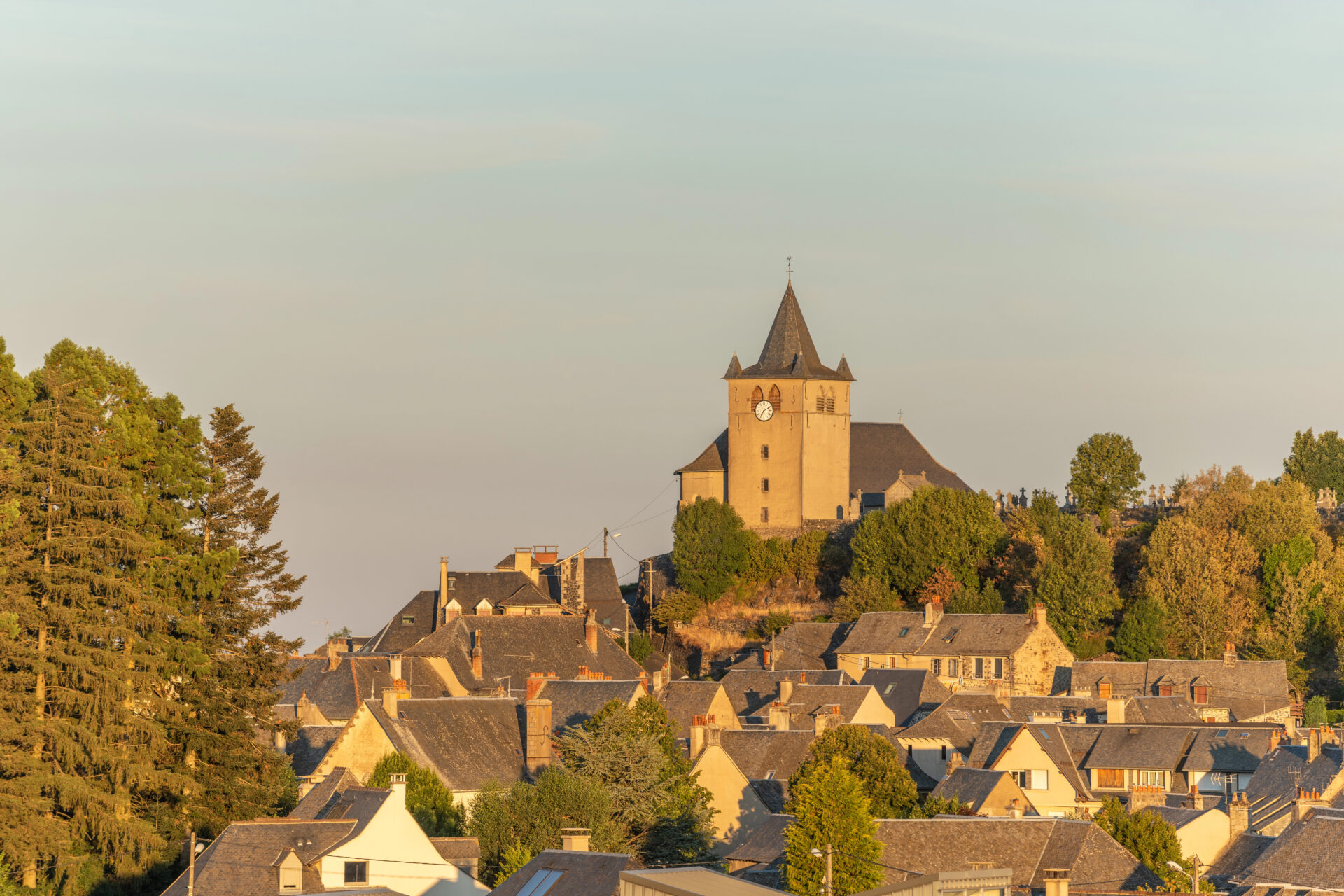
The name Laguiole comes from the Occitan “La Gleisola”, meaning the little church.
Over the centuries, this modest relief church became the main church in the area. The village formed around her, grouped together, pressed against the winds of the plateau.
We pronounce here “Laïole”, according to the language of the past.
Since the Middle Ages, Laguiole has lived by the rhythm of the seasons:
breeding, fairs, exchanges. The great mountain fairs attracted merchants and peasants. They were reputed to be lively — to the point that the famous “justice of Laguiole” was evoked, the white alisier (drelhièr) fairground stick that sometimes settled disputes in an expeditious manner.

Laguiole is inseparable from cattle breeding.
For centuries, herds of Aubrac cows have been moving up to the summer pastures during transhumance. The burons, built of stone and topped with slates, punctuate the pastures. Cheese was once made there in the solitude of the heights.
Even today, Laguiole cheese perpetuates this ancestral cheese tradition, a symbol of a know-how transmitted with consistency.
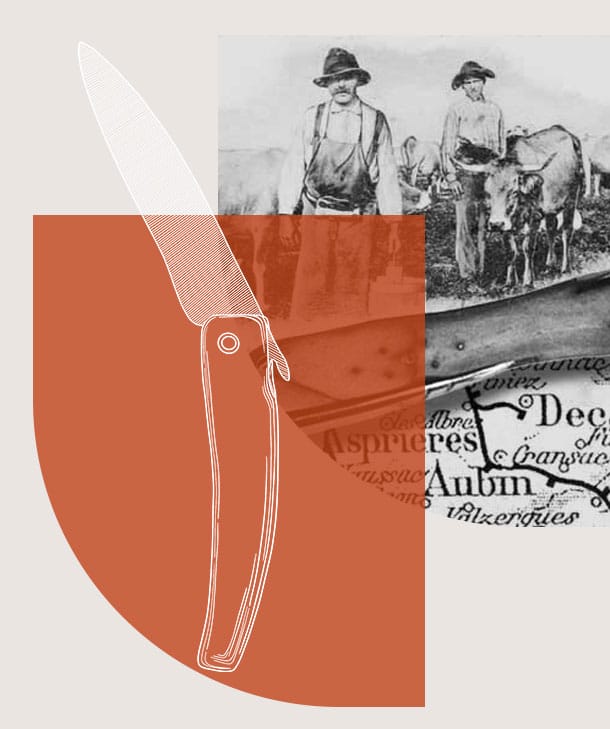
But the history of Laguiole took a decisive turn in the nineteenth century.
In 1829, a folding knife appeared in the village for peasants.
It is inspired by the Spanish Navaja, brought back by seasonal workers who went to work in Catalonia, and the local knife, the Capouchadou.
From this encounter was born a slender and slender silhouette.
Little by little, the Laguiole knife became the emblem of the village.
Its chiseled spring, often decorated with a bee, symbolizes precision and quality of work. The cutlery craft developed, workshops were set up, and Laguiole acquired a reputation that went far beyond the borders of the plateau.
Like many mountain villages in the nineteenth century, Laguiole experienced a rural exodus.
Many of its inhabitants left for Paris. They are called bougnats.
They often start by selling coal, then open cafes and breweries. Some famous Parisian houses — such as Lipp or the Café de Flore — still bear the imprint of these Auvergnats who moved to the capital.
But even away from the stage, they remain attached to their native land.
They founded friendship groups, returned to the festivals, and passed on the memory of the country.
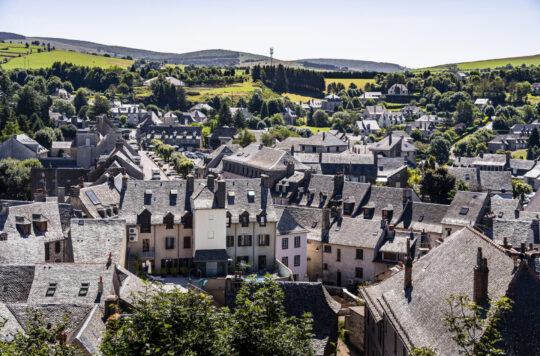
Today, Laguiole remains a stone village, set in the immensity of the Aubrac.
The wind still blows with the same force. The seasons still dictate the rhythm of life there.
Between breeding, cheese and cutlery, Laguiole has managed to preserve what makes up its soul:
the rigor of the work, the respect of the gesture, the attachment to the land.
More than a name engraved on a blade, Laguiole is a place of origin.
A village that, for centuries, has stood upright against the wind — anchored in the mountains, faithful to its history.
The Laguiole knife was born at the beginning of the nineteenth century in the village of Laguiole, on the Aubrac plateau.
Its invention is attributed to Pierre-Jean Calmels, creator of the forced notch mechanism, which has become the technical signature of Laguiole.
Since 1829, this folding knife has embodied French cutlery know-how, artisanal innovation and family transmission.
Between 1827 and 1828, Pierre-Jean Calmels (born in 1813) worked in the family inn in Laguiole.
A customer shows him a Spanish knife, the Navaja.
Seduced by its folding principle, he imagined a version adapted to the needs of the farmers of Aubrac.
With the help of his uncle Belmon, a locksmith, he developed a new mechanism.
➡️ In 1829, the Laguiole knife with a forced notch was born.
At only 16 years old, Pierre-Jean Calmels became a cutler and founded what would become a real dynasty.
Targeted keyword: invention of the Laguiole knife
The Laguiole belongs to the family of folding knives.
The first models sometimes used a so-called “fly” system, probably inspired by the Catalan navajas.
The “fly” referred to a small mechanical part that facilitated closing.
This system was quickly replaced by the forced notch, a major innovation:
it does not completely lock the blade,
but it ensures a firm hold in the open position,
It offers a balance between security and flexibility.
Even today, the forced notch remains an emblematic characteristic of the traditional Laguiole knife.
Keywords: Laguiole forced notch, Laguiole mechanism
The first models preserved are often luxury knives :
ivory handles
Meticulous finishes
Presence of the famous Yatagan blade
The yatagan blade, recognizable by its elegant curvature, quickly became an aesthetic marker of Laguiole.
The simpler horn-handled models, much used by rural people, have rarely stood the test of time because of their intensive use.
Keywords: Laguiole yatagan blade, old Laguiole knife
Around 1840, Pierre-Jean Calmels added a decisive element: the folding punch.
This tool transforms the Laguiole into a real rural multifunction knife.
In particular, it allows:
Harness repair
Leather drilling
the removal of stones under the animals’ shoes
certain veterinary emergency interventions
The Laguiole then became more practical than the capouchadou, which it gradually replaced.
Keyword: Laguiole hallmark
Around 1850, the Laguiole adopted its almost definitive silhouette.
Then the brass bolsters appear at the ends of the handle:
they reinforce the solidity
they protect the handle
they accentuate the so-called “leg” curve
This elegant line contributes to the immediate recognition of Laguiole.
Keywords: Laguiole bolsters, Laguiole knife shape
Pierre-Jean Calmels, nicknamed Bridoulet, inspired many cutlers who had set up shop in particular rue du Valat in Laguiole.
When he died in 1876, his son Pierre Calmels continued the family work.
It adds a slide to the spring, allowing several tools to be operated (blade, punch, then corkscrew).
Around 1880, the corkscrew was permanently integrated into the knife.
This evolution corresponds to the rise in Paris of the bougnats, originally from the Aveyron, working in cafés and restaurants.
The three-room model then became the most widespread:
Blade
punch
corkscrew
The Laguiole knife now accompanies both the peasant and the Parisian bistro owner.
Keywords: Laguiole three-piece, Laguiole corkscrew
The tradition continues with Jules Calmels, then the following generations.
More recently, Nicole and Catherine Calmels have continued the legacy under the name “Calmels et Filles”.
Materials are evolving:
Precious woods
rare species
mammoth ivory fossil
Contemporary materials
But the fundamentals remain:
Forced Notch (1829)
hallmark (1840)
corkscrew (1880)
Yatagan blade
Handcrafted assembly
For nearly two centuries, the traditional Laguiole knife has symbolized:
French craftsmanship
Mechanical innovation
Family transmission
Anchoring in the Aubrac terroir
Born of Spanish inspiration, perfected in Laguiole, distributed in Paris, it remains today an emblem of the French cutlery heritage.
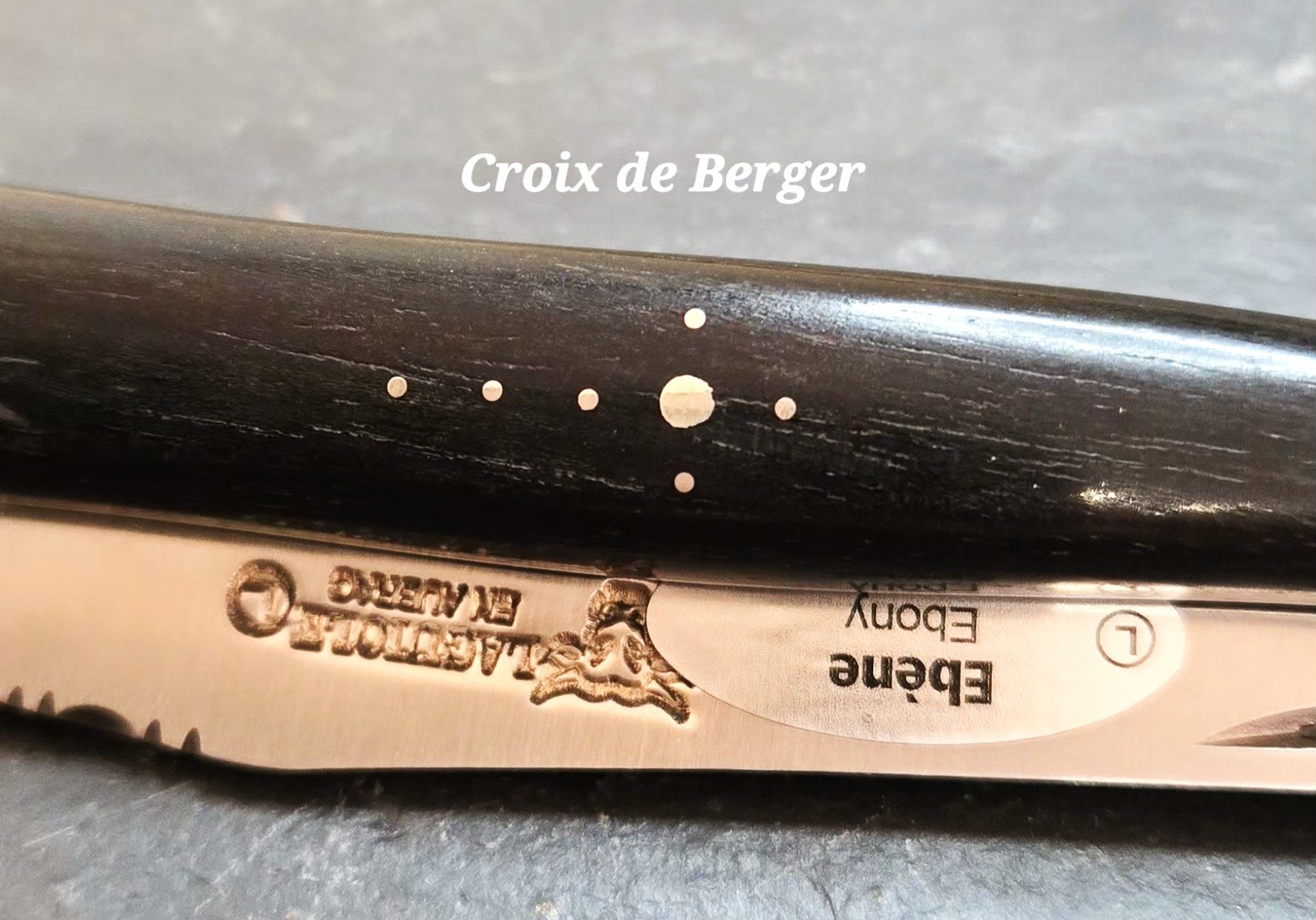
This cross is called the shepherd’s cross. It adorns most Laguiole knives and refers to an ancient tradition linked to transhumance.
In a region historically marked by Catholic culture, shepherds would leave for several months far from villages and places of worship. To pray, they used their Laguiole as an improvised oratory : the knife was stuck in a piece of bread, and the cross on the handle became a symbol of recollection.
The shepherd’s cross is thus a miniaturization of the Holy Cross, sometimes referred to as “the shepherds’ rosary”.
Why is it only present on one side?
Because it was thought of as a visible sign at the time of prayer, when the knife was stuck in the bread, always on the same side.
The motif placed on the Laguiole spring is one of the most discussed subjects. Many see it as a bee, others call it a fly — and some go so far as to evoke a gadfly.
A legend states that Napoleon I granted the inhabitants of Laguiole the right to carry a bee, as a reward for an act of bravery. A variant attributes this origin to Napoleon III.
However, no historical document has come to confirm these accounts. They are more a matter of oral tradition than of established fact.
In terms of cutlery, the Laguiole is one of the so-called “fly” knives. The fly originally referred to a small metal piece (triangular or oval, sometimes equipped with a ring) that was operated to facilitate closure on certain old systems.
With the appearance of the Laguiole with a forced notch, this “fly” lost its mechanical function, but its memory would have remained in decorative form on the spring.
An open question remains: does the decoration represent a stylized fly, a bee, or something else?
For Pierre Calmels (son of Pierre-Jean Calmels), it could only be a bee : a prestigious knife could not, according to him, carry an insect considered too common.
For Jacques Calmels (cutler in Rodez), the motif would rather evoke a horsefly, familiar with the summer pastures and herds in summer.
Today, the debate is as amusing as it is fascinating: the location of this motif is often referred to as a “fly”, even when the shape chosen resembles a bee.
Nowadays, the jurisdiction of the Laguiole is no longer limited to this reason alone. The workshops offer many decorations, worked and often chiseled by hand, such as:
the clover leaf (lucky charm),
the scallop shell (in reference to the way of Saint James that crosses the Aubrac),
smooth plate,
relief decorations (3D),
and many other variations according to the inspiration of the craftsmen.


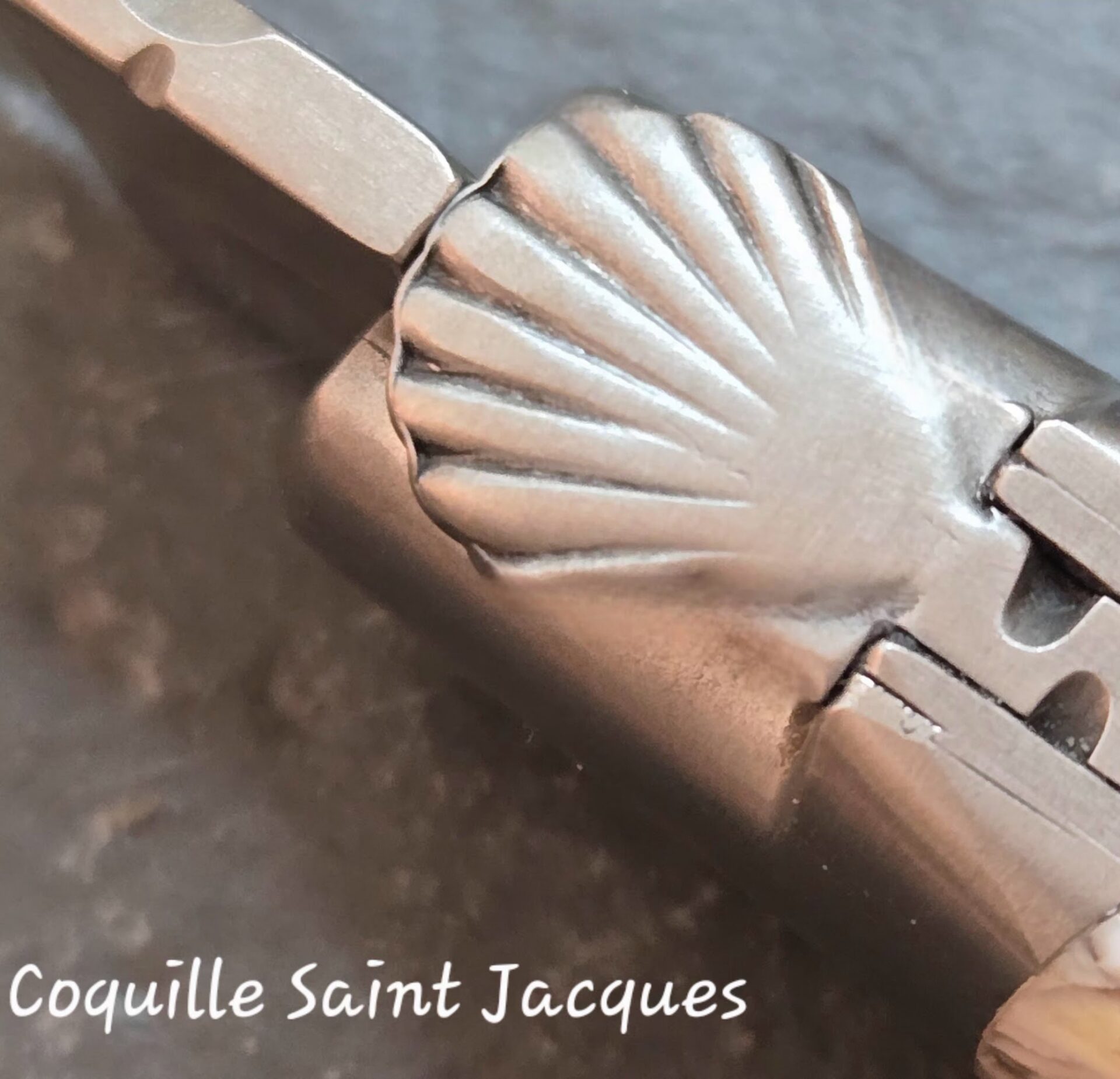
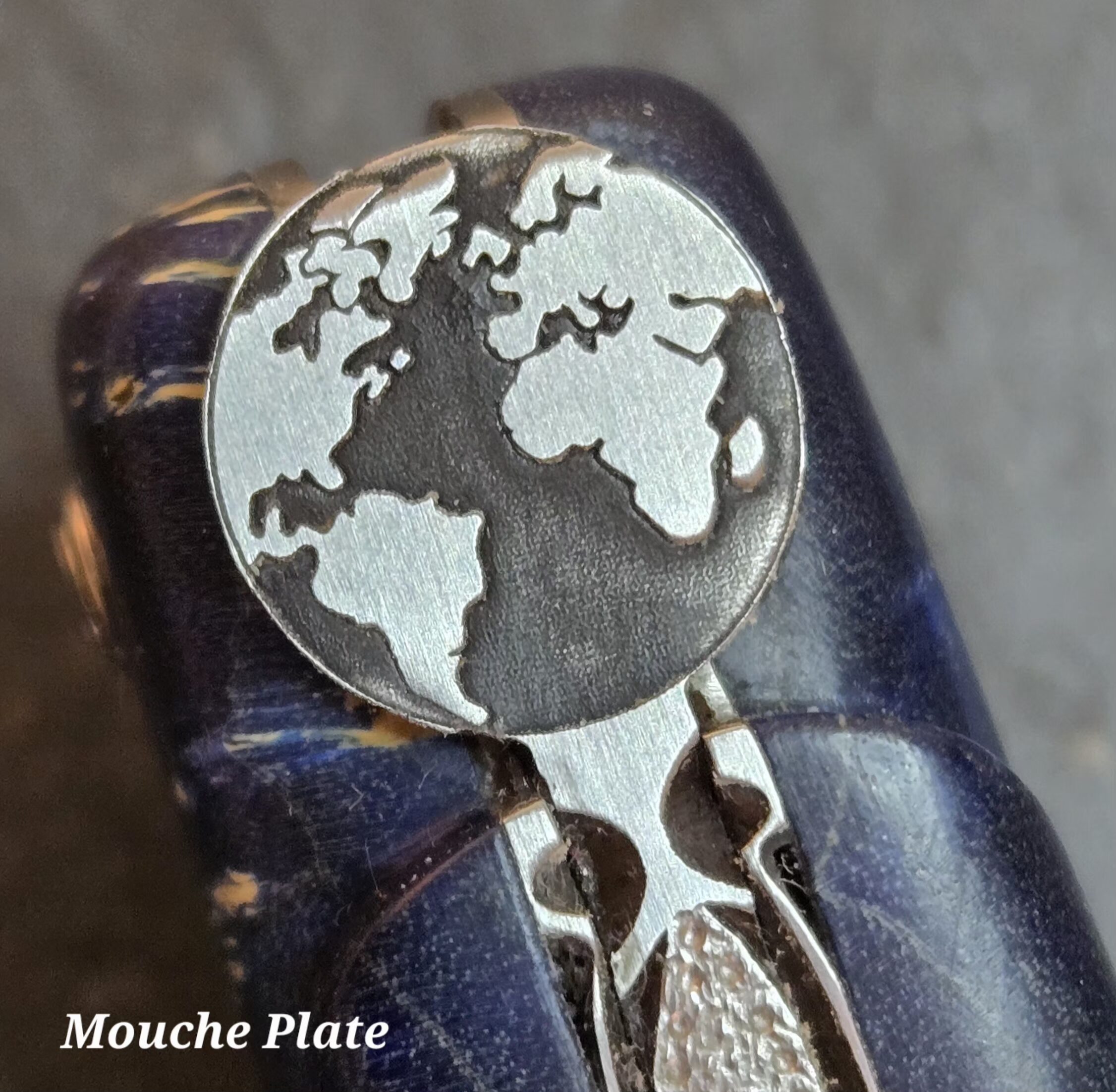

Basically, everyone sees what they want: fly, bee, gadfly… or simply the signature of a know-how.
To each his own interpretation!
If you have been given a Laguiole knife, you should know that tradition dictates that you pay a coin to the person who gave it to you to keep the bond of love or friendship that binds you.
The connoisseur will never close his Laguiole knife by snapping the blade so as not to damage the edge of the blade as well as the spring, in accordance with the Aveyron proverb:
” Silent spring will live better!”
This explains the presence of a stop on your Laguiole knife that protects your blade when it is closed.
At the time, only the patriarch was allowed to snap his blade at the end of the meal to ask the family to clear the table!


