
- Your cart is empty
- Continue Shopping
Gravure Laser Offerte sans délai supplémentaire
Livraison 48h00 en France et dans le Monde entier
Support Rapide 24/24 7/7 par email
99€
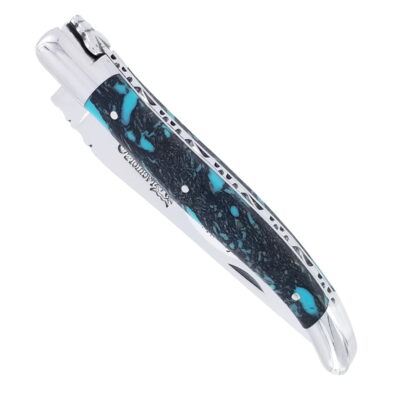
Laguiole folding knife in Aubrac “Le couteau d’ici”
Ergonomic olive handle
WARNING: Closure of the knife by friction mechanism (blocking made by the lens) see video of the knife
Raw blade from Forge
Handle length: 12cm
Blade length: 9cm
Weight: 200g
Total length of the knife 21cm
THE KNIFE FROM HERE, DESIGN AND AUTHENTICITY.
Availability: In stock
The Piedmontese folding knife, with its simple yet effective design, is a classic example of traditional craftsmanship and functional ingenuity. The friction mechanism, characteristic of these knives, adds a rustic and authentic touch to their design.
The term “Piedmontese knife” refers to the geographical origin of these knives, which were first discovered in the Italian region of Piedmont. Their friction mechanism is based on a growth called a lens, a distinctive feature of these knives. The lens acts as a locking mechanism, leaning on the handle to prevent the blade from rotating. This creates extra safety, preventing the blade from accidentally closing when held in position by the thumb or hand.
The authenticity of these Piedmontese knives lies not only in their mechanical design, but also in their connection to the history and tradition of the region. They represent craftsmanship passed down from generation to generation, reflecting the commitment to quality and efficiency.
In addition to their functionality, these knives can also be appreciated for their aesthetics. The details of the design, the quality of the materials used and the care taken in the workmanship contribute to making these knives unique and attractive.
Thus, the Piedmontese folding knife embodies both practical simplicity and cultural authenticity, making it a sought-after object both for its everyday usefulness and for its value as a traditional handicraft.
| Weight | 0.300 kg |
|---|---|
| Finishing | |
| Blade | |
| Wooden handle | |
| Knife composition | |
| Brand | |
| Bolster |
 In stock - Delivery on 23/10/2026
 In stock - Delivery on 23/10/2026
 In stock - Delivery on 23/10/2026
 In stock - Delivery on 23/10/2026
 In stock - Delivery on 23/10/2026
 In stock - Delivery on 23/10/2026
 In stock - Delivery on 23/10/2026
 In stock - Delivery on 23/10/2026


